
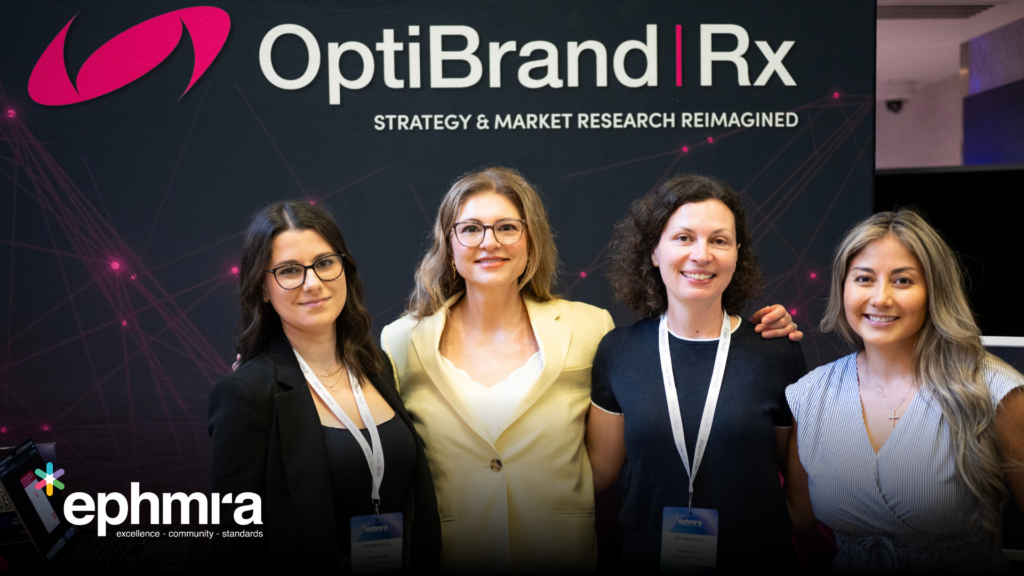
What EPHMRA 2026 confirmed about the future of pharma research — and why the agencies that win won’t be the ones who automate the most.
Every year, EPHMRA gives our industry the same test: can we talk about AI without letting it talk over us?
This year, London answered clearly. Across three days at Leonardo Royal London St Paul’s, the conversation moved past AI hype and into something more useful — a shared reckoning with what AI is actually good at, what it isn’t, and where human judgment still has to do the heaviest lifting. For OptiBrand Rx, that reckoning is not new territory. It’s the argument we’ve been making since before it was fashionable: pharma doesn’t need more data. It needs insight to inspire decisive action. AI can accelerate the first half of that sentence. It cannot do the second half alone.
Here’s what we heard, and what we believe it means for brand teams navigating the next stage of the product lifecycle.
Faster is not the same as better. The expectation walking into any AI conversation is “better, faster, cheaper.” What EPHMRA’s research community made clear is that AI reliably delivers on faster. Better is conditional, dependent on data quality, rigorous validation, and a team that knows what a false outcome looks like before it becomes a false conclusion. Speed without scrutiny doesn’t clarify a brand’s position. It just gets you to the wrong answer sooner.
The verification work doesn’t disappear — it moves. As AI takes on more first-pass processing, the real cost shifts to interpretation: reading the output, checking it against reality, and understanding the emotional and behavioral context that no model fully captures. This is the work we’ve always believed in. We don’t stop at what the data says. We go deeper to the reason behind it or the part of the story a dashboard can’t tell you.
Efficient doesn’t mean cheaper. One of the sharper points to surface at EPHMRA: making a tool easier and cheaper to use tends to increase how much people use it, which can raise total cost and resource draw rather than lower it. Efficiency is a means. It is not, by itself, a business case.
Sequence matters more than volume. The room converged on a hierarchy worth repeating: desk research and primary data collection first, AI synthesis second, layered in to pull together Real World Evidence and social listening once the human-led groundwork is in place. AI performs best as a synthesizer of well-understood inputs, not as the starting point for understanding them.
Synthetic data earns its place carefully. It’s a legitimate tool for validating datasets and filling gaps in predictive models, but only with active management against bias and “noisy” conclusions drawn from thin evidence. Synthetic data is a supplement to judgment, not a substitute for it.
Quantitative and qualitative are converging. AI-enabled survey tools that ask contextual follow-up questions in real time are starting to close the gap between “what happened” and “why it happened,” bringing the why into the same moment as the what, rather than a separate study later. Adoption still varies by market, which is itself a reminder that behavior sets the pace of change.
Forecasting gets sharper when it stays adaptable. AI’s real advantage in forecasting isn’t prediction, it’s integration: pulling together dashboards, interviews, and spreadsheets fast enough to catch conflicts and real-world shifts that static models may miss entirely.
Speed should buy back thinking time, not just delivery time. Timelines will shrink. That’s not in question. What matters is what fills the time AI saves, and the room was clear that rushed work is a false economy. Reinvest the efficiency in sharper strategy, not just faster output.
Not all data deserves equal weight. As information moves from individual tools and projects into broader ecosystem thinking, someone has to decide what matters more and what matters less. That’s not a task AI is positioned to own. It’s a judgment call, and judgment is a human discipline.
The agency’s job is to prove it, not promise it. Across every session, the pressure on agencies was the same: demonstrate AI’s value beyond the hype cycle. That means having a clear, defensible point of view on when AI earns its place in the process, and when traditional, rigorously human-led methods are what the evidence actually requires.
Our take, going forward. None of this is a reason to slow down on AI. It’s a reason to be exact about what we’re asking it to do. At OptiBrand Rx, we treat AI the way EPHMRA’s own agenda treated it this year: a catalyst that belongs at specific points in the process, not as the process itself. Desk research and primary data first. Human interpretation throughout. AI synthesis where it adds real velocity including RWE, social data, forecasting integration, and human judgment everywhere a decision actually gets made.
That’s not a hedge against AI. It’s how we protect the thing what our clients actually came to us for: quality of results, clarity they can trust, and the confidence to act on it.
Curious how AI and behavioral intelligence can strengthen your next research initiative? Learn how OptiBrand Rx combines advanced technology with expert interpretation to uncover insights traditional methods often miss.
Uncover the right direction. Go beyond the data.
OptiBrand Rx — Optimizing Brand Health.
By Ariana Bancu, Phd.
Director of Research, Europe